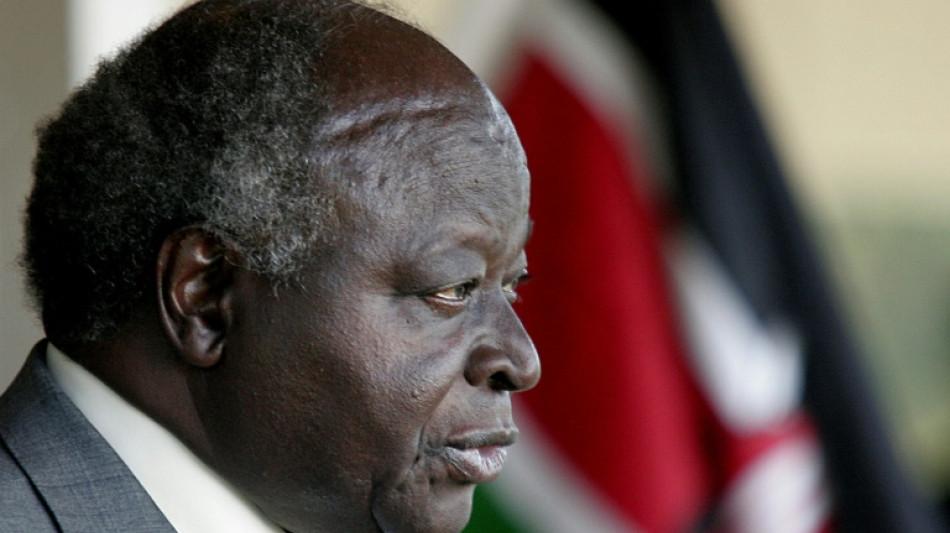
Mwai Kibaki: Former Kenyan president leaves mixed legacy / Photo: © AFP/File

 Ronaldinho returns in search of 'beautiful' 300th goal
 US pushes allies, China to back Trump's economic war on Iran
 Former NBA MVP Harden reportedly set to return to Cavaliers

 Brook makes Pakistan pay for drop as England dominate first Test
 MemeCore Arrives on Nasdaq Through $1 Billion Landmark Treasury Transaction
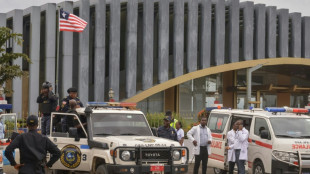 First US deportees land in Liberia
 US, Canada resume talks to finalize trade deal as details emerge
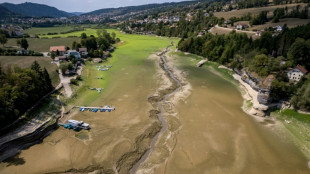 Europe heatwaves scorch 80 million with 40 C heat: AFP analysis

 Carrick insists Man Utd will make more signings after quiet transfer window
 US warns allies, China to back economic war on Iran
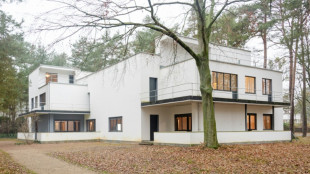 Manifesto defends Germany's iconic Bauhaus against 'populist attacks'

 Kenya's Kipyegon ends season with hamstring injury
 Nord Stream bomb suspect arrested while working on movie about attack: media
 German football fans plan widespread VAR protests
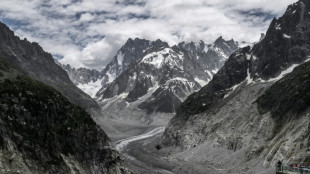 Scorching summer triggers record rockfalls in Alps, scientist says

 Newly-crowned European champ Werro turns focus on 800m record
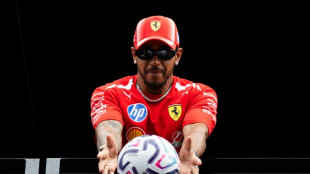 Hamilton 'fittest ever' as he chases eighth F1 title
 Stocks retreat as bond yield fears persist, oil rises
 ARKBRIDGE’s David Mali Highlights AI-Driven Risk Management at the Finance Magnates London Summit
 Zuckerberg buys Gothic castle in Ireland: spokesman
 Belgium's fire of the century now 'under control'
 Evergrande's Xu Jiayin: from real-estate tycoon to life in prison
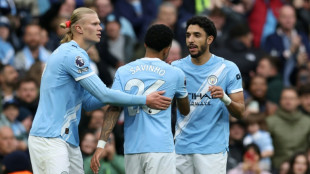 Spurs eyeing move for Man City's Savinho and Marmoush - reports
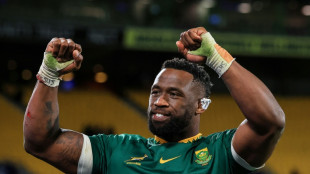 Springboks captain Kolisi to miss first All Blacks Test
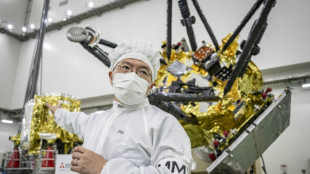 Japan to launch probe for Mars moons in October: space agency
Kenya's third president Mwai Kibaki, who has died at the age of 90, led East Africa's economic powerhouse for over a decade, overseeing some of its bloodiest and most corrupt years but also ushering in a new constitution.
President from 2002-2013, Kibaki was a sharp-witted, wily and veteran leader involved in politics from the very birth of independent Kenya.
"President Kibaki will be forever remembered as the gentleman of Kenyan politics, a brilliant debater whose eloquence, wit, and charm won the day time-and-time again," his successor President Uhuru Kenyatta said in a statement on Friday in announcing his death.
But for a leader who was popularly swept into power in 2002 on an anti-corruption platform, Kibaki's tenure saw graft scandals where hundreds of millions of dollars were siphoned from public coffers.
On taking power in 2002 from the authoritarian rule of Daniel Arap Moi, Kibaki was welcomed for his promises of change and economic growth, but soon showed he was better suited to treading established paths.
"The initial response to corruption was very solid... but it became clear after a while that these scams reached all the way to the president himself," Kenya's former anti-corruption chief John Githongo said in British journalist Michela Wrong's book "It's Our Turn to Eat."
Most notorious of a raft of graft scandals was the multi-million-dollar Anglo Leasing case, which emerged in 2004 and involved public cash being paid to a complicated web of foreign companies for a range of services -- including naval ships and passports -- that never materialised.
- 'Political survivor' -
Yet Kibaki also boosted education and health sectors that were reeling from mismanagement under previous regimes, and launched ambitious infrastructure projects including large-scale road building. His government introduced free basic education for children and revamped hospitals.
"He was a political survivor," said Munene Macharia, a history professor at Nairobi's United States International University Africa.
Closer ties to China also boosted Kenya's economic role, even if critics say Kibaki's drive for growth came at a potential longer term cost for the nation with large-scale borrowing.
Golf-loving Kibaki, who retired with a golden sendoff of $180,000 plus $75,000 a year, also led Kenya during the most violent election in its history, when more than 1,100 people died in ethnic battles after disputed polls in 2007.
After a contentious win that the opposition decried as rigged, Kibaki was hurriedly sworn-in for a second term, prompting further violence that was resolved only after former UN chief Kofi Annan helped broker a deal.
The crisis rocked what had until then been Kibaki's most popular achievement -- a stable economy -- with hundreds of thousands forced from their homes, and Kenya's lucrative tourist industry left in tatters.
"One of his weaknesses was that he paid less attention to the destructive politics... by the time he acted the country was almost at war," said Peter Kagwanja, a former Kibaki adviser and academic.
- Lawmaker for five decades -
Kibaki grew up in a simple farming family in the Nyeri highland district and excelled at school.
He later studied economics and political science at Uganda's prestigious Makerere University and then the London School of Economics (LSE).
He was a lawmaker for five decades -- first elected in 1963 -- and he swiftly rose to be trade minister three years later.
He was also part of the team that drafted the constitution when Kenya became independent from Britain in 1963.
In the chaotic aftermath of the 2007-8 unrest, Kibaki would find himself in the unusual position of presiding over a referendum that overwhelmingly endorsed a new constitution aimed at averting a repeat of the violence.
The 2010 constitution maintained a presidential system, but introduced substantial checks with a devolved system of government.
"His greatest moment was the promulgation of the new constitution... It was a very deep and emotional moment for him," Kibaki's son Jimmy said in a documentary aired when he retired.
But he also left a complicated legacy for his successor Kenyatta who in 2007 had put his own presidential ambitions on hold in favour of Kibaki.
Kibaki kept a low profile since leaving office, making few public appearances. His health had fluctuated since a serious car accident in 2002 and he had been in and out of hospital in recent years.
R.Adler--BTB