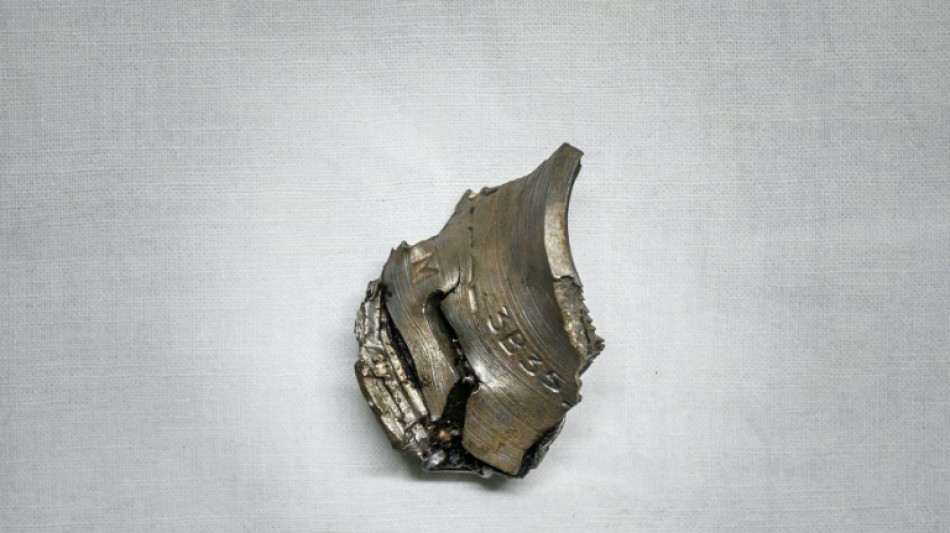
Shrapnel: The terrible fragments of war / Photo: © AFP

 Ronaldinho returns in search of 'beautiful' 300th goal

 US pushes allies, China to back Trump's economic war on Iran
 Former NBA MVP Harden reportedly set to return to Cavaliers

 Brook makes Pakistan pay for drop as England dominate first Test
 MemeCore Arrives on Nasdaq Through $1 Billion Landmark Treasury Transaction
 First US deportees land in Liberia
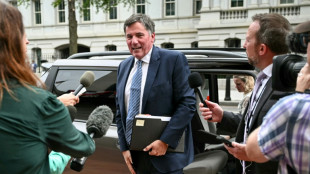 US, Canada resume talks to finalize trade deal as details emerge
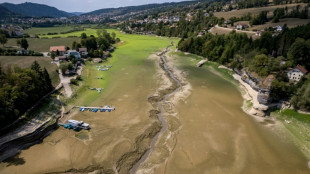 Europe heatwaves scorch 80 million with 40 C heat: AFP analysis

 Carrick insists Man Utd will make more signings after quiet transfer window

 US warns allies, China to back economic war on Iran
 Manifesto defends Germany's iconic Bauhaus against 'populist attacks'

 Kenya's Kipyegon ends season with hamstring injury
 Nord Stream bomb suspect arrested while working on movie about attack: media

 German football fans plan widespread VAR protests

 Scorching summer triggers record rockfalls in Alps, scientist says
 Newly-crowned European champ Werro turns focus on 800m record
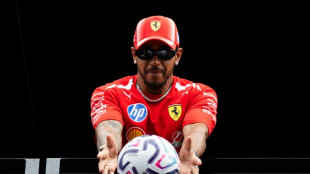 Hamilton 'fittest ever' as he chases eighth F1 title
 Stocks retreat as bond yield fears persist, oil rises
 ARKBRIDGE’s David Mali Highlights AI-Driven Risk Management at the Finance Magnates London Summit

 Zuckerberg buys Gothic castle in Ireland: spokesman

 Belgium's fire of the century now 'under control'
 Evergrande's Xu Jiayin: from real-estate tycoon to life in prison
 Spurs eyeing move for Man City's Savinho and Marmoush - reports

 Springboks captain Kolisi to miss first All Blacks Test
 Japan to launch probe for Mars moons in October: space agency

They differ in size and colour and some still have skin attached: the shrapnel extracted from the wounded at a military hospital in southern Ukraine are the cold reality of the country's war.
In this closely guarded building in the city of Zaporizhzhia, the windows are covered in tarpaulin to avoid drawing Russian fire and to protect patients if the windows shatter from a blast.
There is therefore near total darkness as surgeons come out of an operating theatre with their metallic haul -- two jam jars filled with the shrapnel taken out of soldiers and civilians undergoing treatment at the facility.
Some fragments are bottle green, others grey or brown.
"That's from a mine," said one of the doctors, Yury, pointing to a shard four or five centimetres long.
Every scrap of metal has a story.
Pointing to a particularly sharp shard, Yury said: "We took that one out of a leg. The soldier was in a stable condition and the operation was a success".
On his phone, he showed an X-ray of the wound as it was before the operation. The piece of metal stands out whiter than the muscle in which it was embedded.
Other X-rays show a bullet lodged in someone's jaw or a piece of shrapnel lodged in a pelvis.
- 'We basically live here' -
"Our men are very strong. A large majority of the ones that we treat here, even those who are seriously injured, want to return to the frontline with their friends to support them," Yury said.
An orthopaedic surgeon, Farad Ali-Shakh, said that none of the wounded had died at the hospital and there had only been two limb amputations.
"Their injuries were putting their life in danger," he said.
He too showed a picture on his phone of a blown-off foot, attached to the rest of the body by some skin.
"We managed to restore the vessels and then fix the extremities," said the surgeon.
Ali-Shakh said he is working 20 hours a day.
"We basically live here," he said. "Sometimes I get home at 2 or 3 in the morning and then I come back".
Since the start of Russia's invasion on February 24, the hospital has treated more than 1,000 wounded, including both military and civilians, according to hospital director Viktor Pysanko.
The conflict that began in 2014 with Russia-backed separatists in eastern Ukraine had been "low intensity" and wounds were relatively simple.
The injuries are now much more complex and reflect the range of ordnance being used, Pysanko said, angrily branding Russian soldiers "animals".
M.Ouellet--BTB